Lehman Aftershock 16/09/2009
Posted by chrisdshaw in Uncategorized.add a comment
A fantastic short review by the FT’s John Authers of the three scariest weeks in financial history that followed the Lehman bankruptcy.
FX Daily Update 19/08/2009
Posted by chrisdshaw in Uncategorized.add a comment
The European morning session has traded in a tight range as traders are waiting for further cues about the sustainability of the Asia-led economic recovery. Yesterday’s higher than expected UK CPI figures and European investor sentiment data alleviated the flight to safety earlier in the week. The most significant move in the FX markets this morning came from sterling, which dropped against the USD following Bank of England minutes showing that three MPC members, including Governor Mervyn King, had been voted down over proposing an even bigger boost to Quantitative Easing than was finally agreed. The overall tone of the minutes was also dovish, with the BoE stating that not enogh stimuli could lead to inflation remaining below the 2% target level. It said that although the overall level of risk had receded the depth of recession increased the likeliness of slack in the economy. The more dovish than expected sentiment from the MPC led to the GBP slipping below its 50 day moving average (1.6464) to retrace yesterday’s advance against the USD. However, the decline stalled at 1.6375, holding well above the weekly low of 1.6275. Sterling had started its decline from just under the 1.66 handle in anticipation of the release of the minutes.
In the Eurozone a lack of risk appetite in the European trading day led EURUSD to slip from a high of 1.4170 to the 1.4100 level, with German producer prices declining 7.8% versus and expected fall of 6.5%. This is the largest fall in prices in 60 years. EURUSD has remained above the 1.4092 50 day moving average- an imporant support level that, once breached, may lead to a more bearish move in the currency pair.
The USD, which has firmly reestablished its firm inverse relationship with risk sentiment, has been trading strongly on the back of a quiet but cautious trading day.
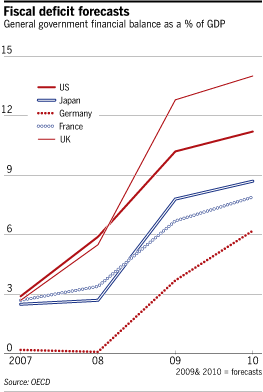
Fiscal Deficit projections 30/06/2009
Posted by chrisdshaw in Uncategorized.add a comment
The OECD maps out the fiscal future G7 countries face over the next 3 years, increasing the pressure on the UK government to map out cuts in public expenditure.
“A historic political week” 03/06/2009
Posted by chrisdshaw in Uncategorized.add a comment
FT’s Westminster blog- hardly the most sensationalist forum, captures the frenzied mood in the UK at the moment.
Australia stays out of recession 03/06/2009
Posted by chrisdshaw in Uncategorized.add a comment
The lucky country posts a better than expected first quarter GDP rise– mostly attributable to an increase in foreign trade. This follows a Q4 2008 GDP fall of 0.6%.
Is Japan turning the corner? 30/04/2009
Posted by chrisdshaw in Economics, Uncategorized.add a comment
RGE Monitor provides the following useful summary of positive indicators
March Rise in Industrial Production Apr 30: Japan’s factory production rose 1.6% in March, a larger increase than had been anticipated, the Ministry of Economy, Trade and Industry said in a preliminary report; this was the first gain in industrial output in six months and may be a sign that Japan’s decline in production and exports is slowly coming to an end (MarketWatch) Industrial production is expected to increase by 4.3% in April and by 6.1% in May, according to manufacturers surveyed (MarketWatch)
Economy Watchers’ Survey– Japan’s Economy Watchers’ Survey is picking up from a bottom in Dec-08. The Watchers’ DI of current conditions tends to lead turning points in the economy by three months, so this turning point may be upon us right now in March-April (Morgan Stanley)
Signs That The Decline In Exports Is Slowing There are signs that the fall in exports is slowing. Thanks to corporate Japan’s agility, inventories have been cut even faster than demand, preparing the ground for a modest rebound in production (FT)
Flexibility In Japan’s Economy Adjustments are happening swiftly in areas that beleaguered companies tackled only slowly during last slump, such as bloated workforces and excessive capacity. Bankruptcies of ‘zombie’ companies long kept alive on cheap credit and an undervalued currency have soared now that credit is harder to get and the yen has risen to a fairer valuation on a trade-weighted basis. And at the end of a decade in which much more use was made of contract and temporary workers, companies are now laying these off fast (Economist)
Rally to continue? 18/04/2009
Posted by chrisdshaw in Uncategorized.add a comment
Risk appetite has been the most important driver of currency markets in the last few months. This is has been due to universally low interest rates, poor economic growth prospects for all the main economies and extremely high volatility. With the rate of economic decline appearing to level off – the “second derivative” as Morgan Stanley economists have recently taken to calling it- and declining levels of volatility, as so much bad news has been priced into the market there is little left to surprise, the panic and flight to risk aversion that had until recently gripped the market, has weakened. More encouraging economic numbers and better than expected corporate earnings from the financial sector have gone some way towards convincing the market that the downturn does indeed have a bottom.
The recent equity market rally has been driven by short term money. Real money investors remain on the sidelines until they are sure that there has been a real sea change in sentiment. Unfortunately, there are significant reasons to suspect that risk appetite is already stumbling and, given the that the rally is about to enter its seventh week- there could be a significant correction. The market rally is tailing off, with a small gain this week could signify that the market is running out of steam; a negative “second derivative” in itself. Economic data from the US this week was indeed better than expected, but the S&P gained only 1% a week.
Equity market performance suggests that the real economy should expect a strong upturn un the future. US economic data released earlier this week suggest that economic deterioration is slowing. Bulls point to the New York and Philly regional indices which both surprised to the upside and the University of Michigan sentiment index which gave its best reading since September. This is indeed cause for hope, but the data merely suggests that expectations for further deterioration have lessened, not that expectations for an improvement have increased. The equity market is behaving as if the problems which have created the financial and economic crisis have been solved; namely the toxic assets on banks’ balance sheets, a sharp reduction in (primarily) US domestic consumption as a direct result of lower household wealth and a return to savings linked to a steadily falling housing market. In fact, none of these problems has been adequately addressed. Continuing signs of a decline in US consumption will bear heavily on the world economy and equity markets until a suitable replacement engine can be found. Similarly, the market will become increasingly nervous in the run up to the results of the US stress test for banks due in early May. If all banks pass, markets will believe the test was too lenient. If some banks fail to pass the test, without immediate government support bankruptcy will ensue. In both cases, stress on the world financial system is likely to resume.
In the meantime, the week ahead should provide important direction for global markets with the meeting of G7/G20 finance ministers at the end of the week. The growing game of currency politics being played between the US and Chinese authorities will be a particular driver. Company earnings season gets into full swing with 33 major companies in the US due to report, including banks and credit card companies. There are risks next week, but the real risks lie in the weeks ahead.
Daily Currency Outlook 16/04/2009
Posted by chrisdshaw in Uncategorized.add a comment
EURUSD: Bearish Sell at 1.3148. Target 1.3080.
GBPUSD: Bullish. Buy at 1.4880*(current spot rate). Target 1.50
USDJPY: Bullish: Buy on dips below 99
Risk aversion has been creeping back into the market in the last couple of hours, as poor economic data from China and the Eurozone has dampened sentiment from an earlier rally in equities in New York and Asia. China showed slightly worse than expected GDP figures- an annualised 6.1% in Q1- while the Eurozone showed continued signs of weakness, with CPI and industrial production data giving their weakest readings since records began at 0.6% and -18.4% year on year respectively. Earlier, equity markets were bolstered by the US Beige Book survey which revealed signs that the financial turmoil may be easing, and data from American Express showing that bad loans had increased at a slower rate in March than in previous months. The JPY has been the chief beneficiary from this bearish sentiment, with EURJPY reaching 129.36, its lowest level since March 31st. The JPY also strengthened earlier against the USD, following the poor Chinese GDP figures. In the UK, the BRC Retail Sales Monitor showed a decline in transactions of 1.2% y/y in March, following a drop of 1.8% in February. Total sales rose 0.6% after a rise of 0.1% in the previous month.
As has been the theme in recent weeks, much depends on risk sentiment which in turn depends on the market’s confidence that the financial system is beginning to function properly again. Figures out from JP Morgan later this morning will be a very important pivot.
Foreign exchange outlook for Event-Risk Thursday 01/04/2009
Posted by chrisdshaw in Uncategorized.add a comment
Currency markets have been relatively quiet of late, perhaps in anticipation of tomorrow and Friday’s important market moving announcements and data. Market has jumped around quite a bit in the last few days, often quite independent of economic figures released. Risk appetite has generally been higher than expected given the diminishing likelihood of anything tangible coming out of the G20 meeting, awful European economic data and the wait for a belated interest rate cut from a reactive and overcautious central bank. One of the main reasons for this, of course, has been the month and quarter end flows moving heavily towards risk; boosting equities and keeping a lid on any advance in the US dollar. However, tomorrow should provide a very different trading environment, as a sudden flight away from risk is likely if either the G20 or the ECB fail to provide detailed proposals to tackle the current crisis. And the likelihood of that is very high.
The US dollar remains the world’s safe haven currency at the moment and could gain strongly against the EUR and GBP if the G20 meeting is seen as a failure. Given the number of substantial issues the meeting is expected to cover- increased funds for the IMF, coordinated fiscal stimulus, supporting world trade and changing regulatory oversight of finance, the outcome is bound to disappoint. This has largely been priced into the market but with increasingly antagonistic noises coming participants, including and increasingly vocal row between the Germans and Japanese over the need for fiscal stimulus, the risk is that the outcome may be something more dramatic than a generic and non-commital communique. Any large scale bust up would lead to a significant retreat from risk and precipitate a sell-off in equities, commodities, Sterling, the Australian dollar, the Euro and a flight to US treasuries and the US dollar. It is difficult to imagine the market not reacting to tomorrow’s announcement and it is almost inconceivable that the result of the meeting will be anything other than disappointing.
The ECB decision tomorrow on interest rates will hopefully provide a clear understanding of the bank’s strategy to provide monetary stimulus and signify how far power has shifted away from the inflation hawks to the doves. The market is expecting a 50bps cut to 1.00%, a new low, although from a record that goes back to 1999 as opposed to 1694. Economic activity has weakened considerably in the region in the last month. Today’s figures show German retail sales falling -0.2% in February (vs the market expectation of +0.3%), the Eurozone Purchasing Managers Index lower and unemployment back up to the levels witnessed three years ago. A rate cut itself will not lead to a move in the market- although in the unlikely event of a 100bp cut, a big jump in the EUR would be expected. Trichet’s press conference, after the announcement, is likely to provide much more scope for currency movements. If the ECB chairman outlines a framework for the introduction of quantitative easing the market is likely to take a sanguine attitude and EURUSD could rise. A statement that strikes a cautious tone or one that lacks clarity will lead to nervousness in the market and a lack of faith that the Eurozone will be able to get itself out of a frighteningly deteriorating situation.
Market Review 30/03/2009
Posted by chrisdshaw in FX, Uncategorized.add a comment
Market Update– With the almost unfathomable amount of event risk this week markets the great bear market rally of March 2008 is likely to come to an end. Overnight in Asia in markets across most asset classes appetite for risk has been waning. Waning faith in a decisive outcome from the G20 and last night’s news that the US government had denied GM and Chrysler additional aid following their failure to provide adequate plans to reduce their debt is weighing on investor sentiment. Equity markets in Europe and Asia are lower, with the Hang Seng closing 4.7% lower, the Dax down 3.5% and the FTSE lower 2.3%. Commodity markets have also taken a battering. WTI Crude is down 3.76%, copper is down 2.8%. In the Foreign Exchange markets the biggest winners have been the USD and the JPY, which appears to have regained- for the time being- its safe haven status. The losers have been GBP and the commodity currencies- the AUD and the NZD.
Data: In the UK house prices fell 0.6%m/m in March, according to Hometrack data. This is the lowest decline since May 2008. Mortgage approvals rose 19% m/m in February. Consumer Credit fell the most since records began in 1993. In the Eurozone, consumer confidence came in at -34, in line with expectations and the lowest on record. Economic confidence was 64.6, a touch less than market expectations. In Japan , industrial production for February was -9.4% m/m, worse than the -9.1% market expectation, making a fall of 38.4% in 12 months.
 Brave New World